Public Domain
Authors: Ronan Deazley, Bartolomeo Meletti and Andrea Wallace
Illustration: Davide Bonazzi
A work – like a book, a song or a film – is in the public domain when there is no copyright attached to it. This means that you can re-use that work for free, without the need to ask for permission from anyone: you can just copy it and use it. When copyright in a work comes to an end, the work is said to enter the public domain. In many countries, such as the UK, this generally happens 70 years after the last creator’s death, bearing in mind that a work may have several creators.
In order to establish if a work is in the public domain you should ask yourself two questions:
1) Who created the work?
2) When did the creator die?
If the creator died more than 70 years ago, his or her works should be in the public domain and can be used in the creation of new work. For example, if you want to create a video game based on Romeo and Juliet, you need to ask yourself: 1) Who authored Romeo and Juliet? Answer: William Shakespeare. 2) When did William Shakespeare die? Answer: In 1616, more than 70 years ago. So, you can create a video game based on Romeo and Juliet without the need to ask for permission. Likewise, you can freely write lyrics for a song using words from The Picture of Dorian Gray (Oscar Wilde, 1854 – 1900) or produce a film based on Oliver Twist (Charles Dickens, 1812 – 1870). You can use the Mona Lisa (Leonardo da Vinci, 1452 – 1519) as your Facebook page background so long as you can find an image of the Mona Lisa that is not subject to a new copyright claim—more on this below; but if you want to use Dora Maar Seated you will have to wait until 2044 for copyright in the underlying artwork to expire (Pablo Picasso, 1881 – 1973).
As well as answering these two questions, when dealing with public domain materials you need to keep in mind three important rules:
1) Different copyright rules apply in different countries
2) A reproduction or recording of a public domain work may qualify for copyright itself
3) An original adaptation or version of a public domain work is protected by copyright
These rules are explained in more detail below:
1) Different copyright rules apply in different countries, so the rules that matter are the rules of your own country (in legal terms: copyright law is territorial). Therefore, the fact that a work is in the public domain in another country like the United States does not necessarily mean that it is in the public domain in the UK as well. Actually, the US and the UK have different rules as to when works enter the public domain. For a guide to the copyright term and the public domain in the US, take a look at this useful resource produced by the Cornell Copyright Information Centre: http://copyright.cornell.edu/resources/publicdomain.cfm.
Some countries recognise shorter or longer terms of protection than the UK. The UK follows the ‘rule of the shorter term’ when calculating copyright in foreign works. This means if the country of publication recognises a shorter term, you can rely on that country’s term for your copyright calculation. For example, for a work published in Japan (Life + 50 years), you can apply the shorter term of 50 years after death under Japanese copyright law. On the other hand, if the country recognises a longer term, you can rely on the UK’s shorter term of protection. For a work published in Mexico (Life + 100 years), you can apply the shorter term of 70 years after death under UK copyright law. Keep in mind that the rule is also territorial. This means your use of the work published in Mexico will be covered under UK law, but not if you plan to release it in Mexico.
2) A reproduction or recording of a public domain work may qualify for copyright itself. For example, a piece of music and a sound recording of that piece of music are two different types of work with two different copyrights. Therefore, the fact that a musical composition is in the public domain does not mean that a recording of that music is in the public domain as well. So if you want to use a Mozart composition in your video, you need to find a sound recording of that composition that is free to use.
The same logic applies to photographs of art and other cultural objects. Similar to recordings of public domain music, there are at least two layers of copyright to consider here: copyright in the underlying work and copyright in the photograph. As discussed below, both layers must be free of copyright for the image to be in the public domain and free for anyone to use it as they see fit.
3) A new adaptation or version of a public domain work will be copyright protected, even though the original work is not. For example, the film Romeo + Juliet starring Leonardo Di Caprio and Shakespeare’s famous play are two different works: the former is protected by copyright because its creator is still alive, whereas the latter is in the public domain as Shakespeare died more than 70 years ago. So, if you want to create a video making use of clips from the film Romeo + Juliet, you need to get permission from the copyright owner (unless you can benefit from one or more copyright exceptions). However, if you want to produce a new film based on the Shakespeare play, you are free to do so.
Another good example is the Bible, the original text of which is in the public domain (its original authors died quite a long time ago). However, many of its adaptations and translations, like the Good News Bible (New International Version), still enjoy copyright, meaning that if you intend to re-use that particular version of the Bible, you need to get permission from the copyright owners.
These two questions and three rules should be helpful when you want to figure out whether a work is in the public domain and whether it can be used without infringing copyright. However, you need to be especially careful when dealing with music, photographic reproductions of works of art and films. You also need to be aware of other types of rights that might affect when you can make use of works in the public domain. We consider these issues next.
Music
The copyright duration of composed music is the same as for books, paintings and other literary and artistic works: the author’s lifetime + 70 years. Therefore, the musical compositions of old masters like Beethoven (1770 – 1827) or Mozart (1756 – 1791) are all in the public domain and you can freely use them. However, as mentioned above, you need to keep in mind that a musical composition and a sound recording are two different works: even if the former is in the public domain, the latter may be still protected by copyright. There is even a third layer of rights you may need to consider. The recording of a performance, such as an orchestra performing a composition by Beethoven, can attract performers’ rights. So, if you want to create a video using one of Beethoven’s compositions, you either need to get all relevant permissions or need to find a recording of that composition that is free to use. Fortunately, copyright’s longer term of protection means performers’ rights will have expired by the time the copyright in the recording expires. A good source of freely available sound recordings is Incompetech, a collection of songs produced by the American artist Kevin MacLeod and distributed under a Creative Commons licence. You can freely use all the songs originally produced by Kevin MacLeod under the only condition of crediting him. But you have to be careful when the song is a reproduction of another composition because – again – copyright law is territorial. So, you can freely use Kevin MacLeod’s recordings of Beethoven compositions, because Beethoven’s work is in the public domain in both the UK and the US. However, until 1 January 2020, you could not use, for example, Richard Strauss’s Also Sprach Zarathustra: this composition has been in the public domain in the US for some time because it was published more than 95 years ago (in 1896), but it entered the public domain in the UK in 2020 only, 70 years after the death of Richard Strauss (1864 – 1949).
Photographs of works of art
Knowing if a photograph of a work of art is in the public domain is somewhat trickier. This is because copyright law and copyright practices don’t always align when it comes to the treatment of photographic reproductions of public domain artworks. For example, you will likely encounter many that are marked with a copyright claim, like ‘© Museum Name’, despite the image failing to meet the legal requirements for copyright protection.
Two main criteria must be satisfied for a photograph of a work of art to be in the public domain:
(a) Copyright has expired in the underlying work
(b) Copyright has either expired or failed to arise in the photograph of that work
Like the other creative works already discussed, copyright in the underlying artistic work will expire based on the artist’s lifetime + 70 years.
If the photograph of that work is sufficiently creative in its own right, its copyright will expire 70 years after the photographer’s death. An example includes a photograph of a work of art on exhibition.
However, if the photograph faithfully reproduces the underlying work, it does not attract a new copyright in the UK, US and EU Member States as it fails to meet an essential requirement for protection: originality. An example includes a faithful photograph, cast or scan of an artwork, like a digital photograph of the Mona Lisa or a plaster cast or 3D scan of Michelangelo’s David (1475-1564). These reproductions are in the public domain from the moment of their creation.
The case of THJ Systems Ltd v Sheridan [2023] EWCA Civ 1354 clarified that UK copyright law, like EU copyright law, requires a work to be ‘the author’s own intellectual creation’ for it to be original and therefore attract copyright protection (see also the UK Intellectual Property Office’s Copyright notice: digital images, photographs and the internet). This means a photograph of a work of art will attract an independent copyright only if creative choices are made that result in the photograph being imprinted with the photographer’s personal touch. A stylised image, such as one that intentionally departs from industry standards on lighting, angles and background selection, may qualify if those decisions produce a new creative expression. However, this is not usually the case with artwork reproductions, where the goal is to depict the underlying work as faithfully as possible. That said, many cultural institutions assert copyright in faithful reproductions of public domain works and further restrict public reuse through website terms and conditions.
Given the divergence in copyright law and practice around of these photographic reproductions, if you want to make use of a photograph of a work of art the best thing to do is to search for one that is explicitly free to use. A good source for this is Wikimedia Commons, a database of millions of freely usable media files, like images, sounds and videos. For a list of cultural institutions that release their digitised public domain collections under free reuse terms, you can also browse the Open GLAM Survey: https://survey.glamelab.org/.
Films
Knowing if a film is in the public domain is complicated because so many people and types of copyright works are often involved in its production. According to UK copyright law, in order to know if a film is in the public domain you need to identify the following creators:
(a) the principal director
(b) the author of the screenplay
(c) the author of the dialogue, and
(d) the composer of music specially created for and used in the film
Copyright in the film expires 70 years from the end of the calendar year in which the last person listed above dies.
A good source of freely available films is the Prelinger Archives, a collection of movies that are supposed to be in the public domain in the US. However, remember that copyright law is territorial. So, while a film from this archive might be in the public domain in the US, it may still be in copyright in the UK, and identifying the copyright owner may not always be easy. Indeed, many of the films contained in the Prelinger Archives are orphan works: works that are in copyright but whose copyright owner is unknown or cannot be traced.
Fortunately, there are some films in the Archive that we can definitely say are in the public domain in the UK. For example, Le Voyage dans la lune is a silent movie in which there is neither dialogue nor music; moreover, the director and author of the screenplay is the same person: Georges Méliès (1861 – 1938), who died more than 70 years ago. You can safely make use of Le Voyage dans la lune in any way you like.
Script, images, footage and music are not the only copyright works involved in the production of a film. Intellectual property rights exist also for brand names, logos, fonts, texts and designs, which makes everything more complicated. For a rich educational resource on copyright for filmmakers, see The Game is On!
Characters from a dramatic or literary work
The case of Shazam Productions Ltd v Only Fools the Dining Experience Ltd [2022] EWHC 1379 IPEC has stated that a literary character can be protected as a literary work, so long as the character is original subject matter qualifying as a work and the character is identifiable with sufficient precision and objectivity. That said, any copyright in such characters will expire alongside the copyright in the literary work. As an example, both the character of Sherlock Holmes and the series by Arthur Conan Doyle are in the public domain.
However, it should be noted that new iterations of characters can attract a new copyright protection separate from that of the original character. Because copyright in the original Sherlock Holmes series expired in 2001, author Nancy Springer was free to write the The Enola Holmes Mysteries series. Springer created the character Enola Holmes as the 14-year-old younger sister to Sherlock Holmes, borrowing other characters and details from Doyle’s books. She was able, because Doyle’s literary works are in the public domain. Springer now owns copyrights in the new literary series and Enola Holmes character. This means anyone can create spinoffs of characters and stories that take place in the world of Sherlock Holmes, but they cannot include Enola Holmes in that world without considering copyright law.
Another example includes the Steamboat Willie version of Mickey Mouse. This early version of Mickey passed into the public domain in 2024 along with the expiration of the 1928 short film, ‘Steamboat Willie.’ More modern versions of Mickey remain unaffected by the expiration of the Steamboat Willie copyright. This means you can make a horror film starring the Steamboat Willie Mickey, but you will need a licence from Disney to use newer versions of his character.
Other rights
It is important to know that while a work per se might come out of copyright, some of its elements – like the literary characters – may remain protected by other forms of intellectual property, particularly trade mark law.
In addition to copyright, literary characters, represented by their names and drawings primarily, can also be protected under trade mark law. This means that if you were to create a video game around a character from a public domain work, you could still be breaching trade mark law. For example, many of the names and illustrations from Beatrix Potter’s children’s books have been registered as trade marks, although her work is out of copyright (Beatrix Potter, 1866 – 1943).
It is also important to note that the more famous the character or film is, the more difficult it can be to register it as a trade mark. To deal with this apparent paradox, creators now often register their literary characters as trade marks before they become famous, which could create a problem for anyone who wants to use those characters when copyright expires and the work enters the public domain.
Another relevant consideration to bear in mind when dealing with public domain materials is that the creative selection and arrangement of public domain works can be protected by copyright. For example, even though Leonardo da Vinci’s individual paintings are in the public domain, a book containing a selection of his work presented in a particular order might be protected as a new work. This means that you will be able to re-use the individual images so long as no new rights are claimed in them, but if you want to copy or distribute the complete collection you will need to get permission from the copyright owners of the book.
Curiosities
Although JM Barrie died in 1937, his most famous work, Peter Pan, is still in copyright. An amendment to the 1988 Copyright Designs and Patents Act was passed to allow the copyright for Peter Pan to run indefinitely in the UK; royalties are to be allocated to the trustees of the Hospital for Sick Children, Great Ormond Street, London, for as long as the hospital exists. For further information, see: http://www.gosh.org/gen/peterpan/copyright/
Also, some very old unpublished works remain in copyright until 31 December 2039, even though their authors have been dead for hundreds of years. Imagine, for example, that you discovered an unpublished manuscript by William Shakespeare. As incredible as it seems, that unpublished manuscript would still be in copyright today. For further information on this odd situation, see: https://www.gov.uk/government/consultations/reducing-the-duration-of-copyright-in-certain-unpublished-works
Legal Language:
In the case of THJ Systems Limited v Sheridan [2023] EWCA Civ 1354, Lord Justice Arnold held the lower court had applied in error the “skill and labour” test for originality, rather than the test of “author’s own intellectual creation” as laid down in Infopaq International A/S v Danske Dagblades Forening (C-5/08) EU:C:2009:465. Under the author’s own intellectual creation test:
‘What was required was that the author was able to express their creative abilities in the production of the work by making free and reactive choices so as to stamp the work created with their personal touch[…]. This criterion is not satisfied where the content of the work is dictated by technical consideration, rules or other constraints which leave no room for creative freedom.’
Not all characters from a dramatic or literary work will receive copyright protection. In Shazam Productions Ltd v Only Fools the Dining Experience Ltd [2022] EWHC 1379 IPEC, the court followed the Cofemel test when determining whether the character in question was protected by copyright. The Case C-683/17 Cofemel v G-Star Raw [2020] EDCR 9, the CJEU stated two conditions must be satisfied for copyright to subsist:
‘First, […] that there exist an original subject matter, in the sense of being the author’s own intellectual creation.
Second, classification as a work is reserved to the elements that are the expression of such creation.’
As applied to characters, this means the character must qualify as an original creation and be “sufficiently complex and distinctive” [120].
Legal References:
The law on the duration of copyright in the United Kingdom is found in Sections 12-15 of the Copyright Designs and Patent Act 1988, which you can read here:
http://www.legislation.gov.uk/ukpga/1988/48/part/I/chapter/I/crossheading/duration-of-copyright
Copyright and the Value of the Public Domain, by Kris Erickson, Paul Heald, Fabian Homberg, Martin Kretschmer and Dinusha Mendis (2015), available at:
https://www.gov.uk/government/publications/copyright-and-the-value-of-the-public-domain
Resources useful for navigating copyright and open access to public domain collections can be found in the GLAM-E Lab’s portfolio of polices, tools and projects: https://www.glamelab.org/
Related
The Game is On! – Ep. 1
In a fictional land called London, Sherlock Holmes and John Watson meet a curious client: the toymaker Joseph …
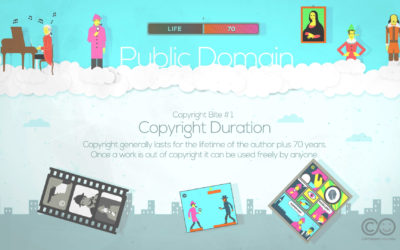
Copyright Bite #1
Copyright Bite #1 considers how long copyright lasts and what it means to say that a work is protected by copyright or in the public domain.
Copyright in SMEs
This section provides guidance on strategies that creative firms have employed to effectively manage copyright challenges.







Most of the original content on the Copyright User’s website is distributed under a CC-BY 3.0 licence, meaning that you can share, remix, alter, and build upon Copyright User content for any purpose, as long as you credit the author of the content. Where content on Copyright User is not distributed under a CC-BY 3.0 licence, this will be indicated clearly.